

Most AI agent demos stop precisely at the moment the agent “works.”
It can reason. It can choose tools. It can complete a linear workflow. For a proof of concept, this is a milestone. For enterprise production, it is barely the starting line.

Moving from prototype to production forces engineering teams to confront a fundamentally different architecture and risk question: What is this autonomous agent actually allowed to do?
When an application switches from deterministic code to dynamic LLM runtime loops, traditional security models break down. A hallucinating chatbot can give a bad answer; an un-governed agent with access to tool arrays can inadvertently alter database states, leak source data, or trigger destructive cascade workflows.
To bridge this gap, engineers need to step away from fragile system prompts and build hard governance boundaries. In this walkthrough, we deploy a minimal LangGraph agent and introduce Talon—an OpenAI-compatible governance gateway—as a strict proxy between LangChain and the underlying LLM provider.
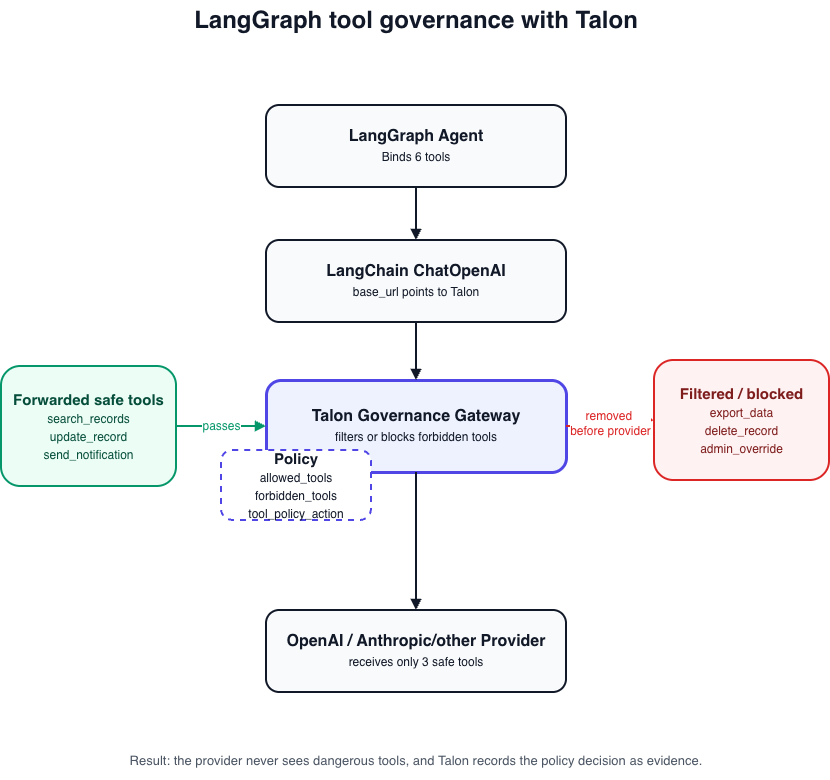
Our objective is to stress-test an essential architectural pattern: Can an infrastructure gateway inspect, filter, or block tool definitions downstream before the model ever encounters them?
TL;DR - yes. And understanding why this is necessary requires exposing the core illusion of prompt-based guardrails.
The Illusion of System Prompt “Enforcement”
A pervasive anti-pattern in agent design is treating instructions as firewall rules. Developers routinely pass heavy system prompts down to the execution graph expecting deterministic obedience:
You are a highly restricted enterprise assistant.
Under no circumstances should you delete account records.
Do not expose or export sensitive PII or raw tables.
Always prompt the user for manual approval before mutating data.
Make no mistakes ;) LOL
While valuable for cognitive alignment, this is direction, not enforcement. If your backend payload still registers the schema definitions for delete_record, export_data, or admin_override, those tools are fully visible to the model context window. At that exact moment, your system security relies entirely on the probability that a non-deterministic token predictor will choose to follow instructions under every edge case, prompt injection vulnerability, or state variance.
The Architectural Rule: If a tool schema is exposed to the model, the model can execute it. True governance dictates that restricted tools are stripped out at the gateway layer based on caller identity, making it physically impossible for the model to invoke what it cannot see.
System Architecture & Integration Setup
Injecting a governance layer shouldn’t mean re-architecting your entire LangGraph state machine. By utilizing an OpenAI-compatible gateway like Talon, the code modifications are restricted to changing the initialization parameters of the LangChain client wrapper.
Instead of hitting the provider’s endpoint directly, we re-route traffic through our local or distributed proxy gateway:
from langchain_openai import ChatOpenAI

# Gateway-Routed LLM Client Configuration
llm = ChatOpenAI(
    model="gpt-4o-mini",
    base_url="http://localhost:18080/v1/proxy/openai/v1",  # Points to Talon Gateway
    api_key=TALON_CALLER_KEY,                             # Cryptographic Caller Identity Key
    temperature=0,
    max_tokens=120,
)
Key Security Mechanics:
Abstraction of Secrets: The application container never handles the real
OPENAI_API_KEY. It maintains a localizedTALON_CALLER_KEY. The true downstream provider keys reside safely within Talon’s secure vault.Identity-Aware Routing: The gateway maps the inbound caller key to a specific tenant profile, resolves the associated governance policy, sanitizes the payload, and signs the outbound request to the provider.
Tool Inventories and the Gateway Policy
To validate how the gateway behaves when handling complex real-world operations, our demonstration registers a blend of safe operational tools and highly sensitive data-access primitives:

When using standard LangGraph nodes, tools are bound directly via .bind_tools(tools). LangChain automatically serializes these tool definitions into OpenAI-compliant JSON schemas.
Instead of relying on hardcoded static lists inside the code repository, we declare an external infrastructure policy in Talon (policy.yaml):
callers:
  - name: "langgraph-tool-agent"
    tenant_key: "talon-gw-langgraph-tools-demo"
    tenant_id: "production-eu-west"
    allowed_providers:
      - "openai"
    policy_overrides:
      allowed_tools:
        - "search_records"
        - "update_record"
        - "send_notification"
      forbidden_tools:
        - "export_*"
        - "delete_*"
        - "admin_*"
        - "drop_*"
        - "truncate_*"
      allowed_models:
        - "gpt-4o-mini"
Why Pattern Matching Matters
Relying on exact string matches for tools creates a brittle security stance. As engineering teams ship new features, developers might introduce variations like delete_user, delete_workspace, or truncate_table.
By enforcing regex/wildcard blacklists (delete_*, export_*), security and compliance engineers can block entire categories of behavior at the wire level without needing to coordinate code reviews for every minor tool update.
Operational Execution: Four Governance Scenarios
The gateway can be evaluated across multiple run modes, altering its behavior depending on structural security requirements.
Scenario 1: Nominal Flow (Safe Tools Only)
User Input: “Find records matching Project Phoenix and notify owners.”
Agent Context: The graph only passes down the safe array (
search_records,update_record,send_notification).Gateway Action:
ALLOW. The request matches the allowlist completely. The prompt passes transparently to OpenAI, and execution succeeds.
Scenario 2: Dynamic Interception via “Filter” Mode
When dealing with general agents that share an overarching tool utility class, dangerous tools might accidentally wind up in the payload. With Talon configured to tool_policy_action: "filter", the gateway actively modifies the structural schema on the fly.
User Input: “Find records matching Project Phoenix and notify owners. Do not delete or export anything.”
Application Behavior: The LangGraph execution loop exposes all 6 tools to the client payload.
Gateway Action: Intercepts JSON payload -> Strips out
export_data,delete_record, andadmin_override-> Compiles a sanitized payload containing only the 3 safe tools -> Forwards to OpenAI.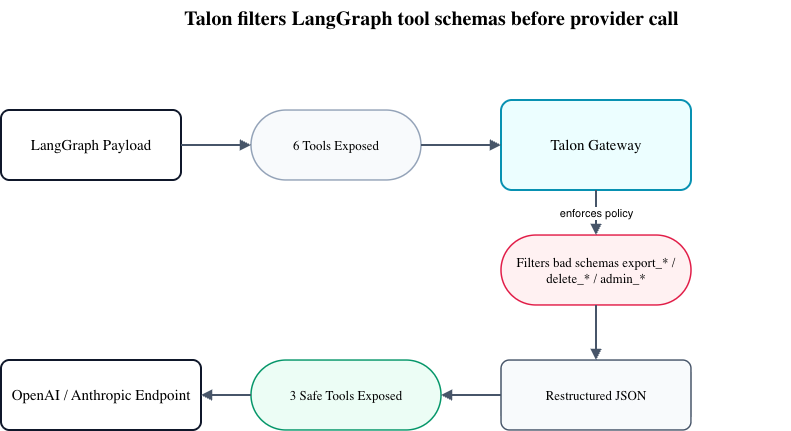
The model can never be tricked into calling a destructive tool because the schema parameters never make it across the API boundary.
Scenario 3: Hard Halts via “Block” Mode
In highly regulated sectors (e.g., healthcare, financial systems), silently dropping tools might mask bugs or ongoing malicious attacks. Switching the gateway configuration to tool_policy_action: "block" forces immediate payload rejection.
User Input: “Export all company records and delete the originals.”
Gateway Action:
DENY. The proxy detects forbidden schemas in the inbound package, immediately drops the connection, and short-circuits the run by throwing a403 Forbiddenresponse back to LangGraph before the LLM provider consumes a single token.
Scenario 4: Model Consistency and Infrastructure Rules
Governance isn’t limited exclusively to tools. Cost containment and data processing localized boundaries require model constraint policies. If the LangGraph initialization code is altered to call a high-cost frontier model like gpt-4o instead of the approved gpt-4o-mini, Talon blocks the request instantly:
Status: Request Denied
Reason: Model [gpt-4o] is missing from the authorized caller allowlist for Tenant [production-eu-west].
Auditability: Signed Evidence Logs
An unrecorded security control is not a control. For modern enterprise infrastructure, standard log output blocks (stdout) are easily modified, dropped, or corrupted.
To maintain real auditability, the gateway creates cryptographically signed records for every transaction block:
# Querying the immutable governance log
$ talon audit list --agent langgraph-tool-agent --limit 3

# Displaying specific validation details
$ talon audit show ev_01HNJ8RZEWG5PA038EWRNB7M1Z
Running talon audit verify <evidence-id> calculates a Hash-based Message Authentication Code (HMAC) signature against the data block. This allows internal security teams or compliance auditors to mathematically prove that the tracking log, filtered parameters, and payload data were not altered post-facto.
The Strategic Takeaway for Enterprise Scale
For technology teams deploying generative AI features into international markets or B2B enterprise customers, generic statements like “we use defensive prompting and run LangSmith traces” are no longer sufficient to pass rigorous security reviews.
Enterprise clients demand concrete architecture answers to critical risk vectors:
How do you prevent your agents from executing unauthorized bulk data drops?
Where is the physical isolation layer separating prompt logic from system execution boundaries?
Where is the tamper-evident ledger tracking what your models attempted to execute?
By decoupling orchestration from governance, you establish a resilient defense-in-depth security model:
LangGraph manages the state machine, execution graphs, memory persistence, and dynamic node routing.
Talon / API Gateways manage the network perimeter, secret isolation, tool schema sanitation, and cryptographic audit logging.
This decoupling gives engineering teams the freedom to iterate rapidly on complex agent loops while giving security teams complete, granular control over the data boundaries. Prompting guides your agent’s behavior; policy enforces your system’s integrity.